To acquire a customer you need four things working together, a specific person you are targeting, an offer that person finds worth acting on, a channel that reaches them at the moment they are willing to buy, and measurement accurate enough to tell you which of those three is broken. Most businesses start at the channel and skip the other three, which is why a Meta account can burn S$20,000 without producing a profitable customer. Acquisition is a system, not a campaign, and the sequence you build it in determines whether it works.
This guide walks through that sequence in six steps, with the checks to run at each one before you increase spend.
To acquire a customer means to move a stranger through awareness, consideration, and purchase at a cost your margins can absorb. The purchase is the visible event, but the acquisition is the whole chain of decisions that made it possible: who you targeted, what you offered, where you reached them, and what the landing experience did with the click.
The distinction matters because businesses routinely optimise the wrong link. A team will rebuild creative for three months when the actual failure is a landing page converting at 0.8 percent, or blame the ad account when the offer has no reason for anyone to act now.
Customer acquisition is the repeatable process of turning strangers into first-time paying customers at a known, sustainable cost. It differs from marketing generally, which includes brand and retention work, and it differs from a single campaign, which is one execution inside the process. The measure of an acquisition system is not how many customers it produced last month but whether it produces them predictably at a cost per customer you can forecast.
For the underlying economics, see our guide to the customer acquisition cost formula and what counts as a good CAC.
Because they begin with a channel decision. Someone decides the business needs TikTok, or Google Search, or a newsletter, before anyone has defined who is being sold to or why they would buy today rather than in six months. Channel is the last decision in the sequence, not the first, and getting it out of order is the single most common reason acquisition spend produces nothing.
The second failure is scaling before measuring. Spending more on a system you cannot measure does not produce more customers, it produces a larger unexplained number. Fix attribution before budget, every time.
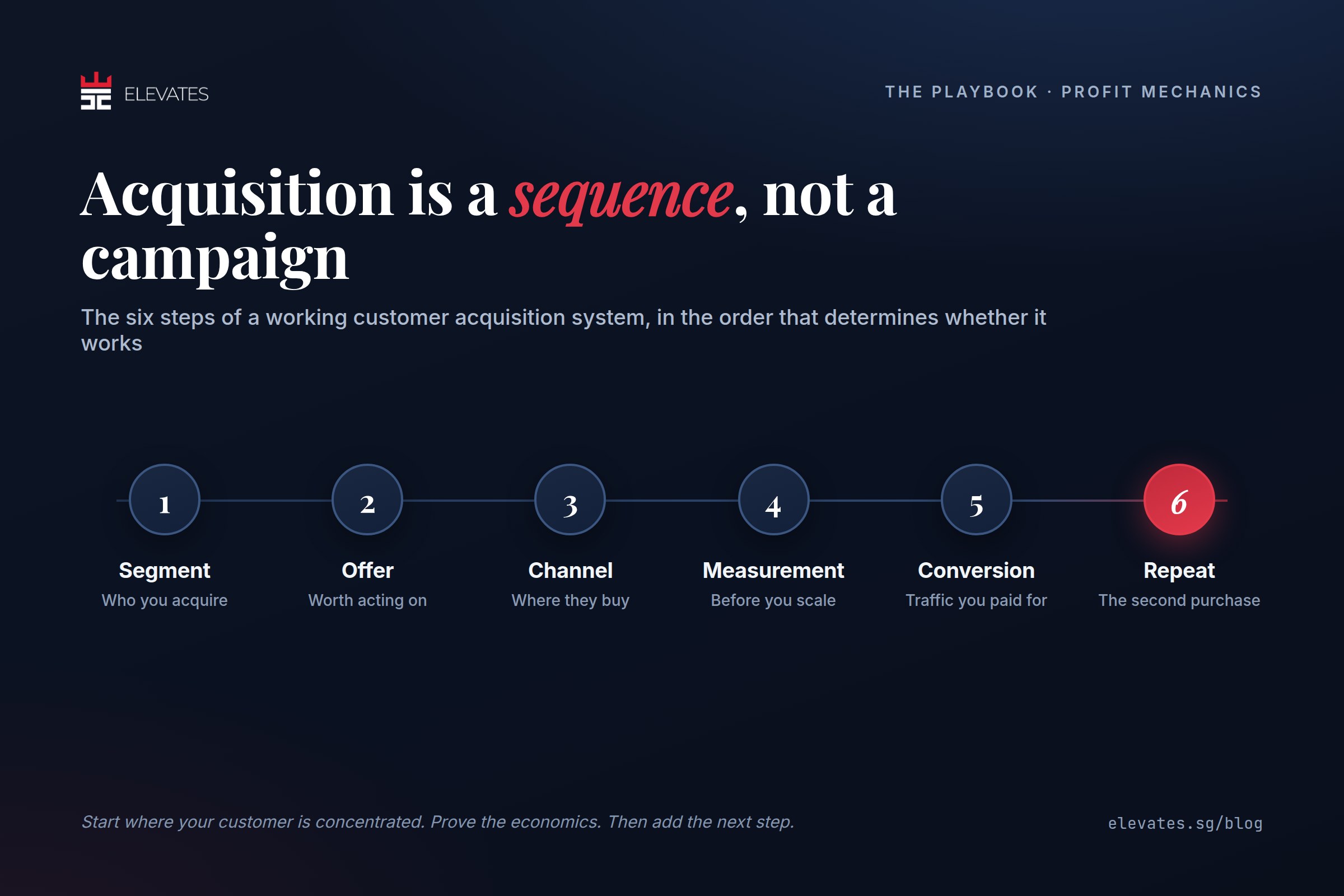
Start with the customer segment that is easiest to acquire and most profitable to keep, which is rarely your largest addressable market. Build the definition from your own data: pull your last 100 customers, sort by repeat purchase rate or contract value, and look at what the top quartile has in common. That is a real segment. A demographic guess written in a strategy deck is not.
Three things to write down for that segment: the problem they are already trying to solve, the language they use to describe it, and what they are currently doing instead of buying from you. That last one is your real competitor, and it is usually inertia rather than a named brand.
An offer is worth converting on when it reduces the risk of saying yes to something close to zero. Price is only one lever and usually the weakest one. The stronger levers are guarantee, bundle, sequencing, and specificity. A supplements brand offering a first-time bundle at S$39 with free local shipping and a money-back guarantee is removing three separate objections at once, which is why it outperforms a flat 10 percent discount.
Test the offer before you test creative. If the offer is weak, better ads only buy you more expensive traffic to the same dead end. A useful check: could a competitor copy your offer word for word next week? If yes, the offer is doing no work and the acquisition cost will be set entirely by the auction.
Choose channels by how your customer buys, not by where you are comfortable. Demand-capture channels such as Google Search work when people are already looking for what you sell. Demand-generation channels such as Meta Ads and TikTok work when people do not know your category exists and need to be interrupted and convinced. Selling a novel supplement into a market that does not search for it is a demand-generation problem, and buying search ads for it will underspend and underperform.
Channel cost differences are large and worth knowing before you commit. In published 2026 B2B data, referral acquisition runs roughly US$141 to US$200 per customer, paid search and PPC average around US$802, and organic content and SEO land between US$500 and US$1,500 per customer with a much longer payback and a compounding return. Average Google Ads cost per click reached about US$2.69 in 2026, with Shopping ads at roughly US$3.49, so the arithmetic on any paid plan starts from a click price you do not control.
The practical rule: start with the one channel where your customer is most concentrated, prove unit economics there, then add a second. Running four channels badly is the most reliable way to learn nothing from any of them.
Install measurement before you scale, because every downstream decision depends on it. That means a correctly configured pixel plus server-side tracking through the Conversions API with proper event deduplication, a single source of truth for what counts as a customer, and a reconciliation between what the platform reports and what your Shopify or CRM backend actually recorded.
The gap between reported and real is not small. One 2026 benchmark analysis found paid CAC now runs roughly 2.4 to 3.1 times blended CAC across most categories, which means teams comparing the wrong two numbers are routinely misreading their own performance by a factor of three. Decide which number you optimise on, label it clearly in every report, and do not switch mid-quarter.
One more check that costs nothing: confirm no second tool is firing duplicate server-side events. Duplicate conversion sources inflate reported results and quietly teach the algorithm to optimise toward noise.
Conversion rate is the cheapest acquisition lever available, because it lowers cost per customer without buying a single extra click. Doubling a landing page from 1.5 percent to 3 percent halves acquisition cost per customer instantly, which no amount of bid optimisation will match.
Work the sequence in this order. Message match first: the ad promise and the page headline must be the same promise in the same words. Then page speed and mobile layout, since most paid traffic in Singapore arrives on mobile. Then friction in the form or checkout, removing every field that is not required to fulfil the order. Then proof placed near the decision point, meaning reviews and guarantees beside the button rather than buried at the bottom.
Cart abandonment is the largest single recovery opportunity for e-commerce, with typical abandonment rates above 70 percent. An abandoned cart flow in Klaviyo recovers customers you have already paid to acquire, at close to zero marginal cost.
The first purchase rarely pays for the acquisition. A brand with a S$200 CAC, a S$95 average order value, and a 60 percent gross margin earns S$57 on the first order and needs three to four purchases to be whole. The business is won or lost in what happens after the first order, not before it.
Build the second purchase deliberately: a post-purchase flow that sets expectations and delivers value before it sells again, a replenishment or subscription option where the product allows, and a reason to return that is not a discount, since discounting habitually trains customers to wait. Every point of repeat purchase rate lowers your effective cost to acquire a customer, because it raises what each acquisition is worth.
Plan for 90 days before you judge a new acquisition system, and longer for considered purchases or B2B, where the average B2B SaaS sales cycle now runs around 134 days. Judging a channel at week three usually means killing something that had not yet accumulated enough conversion data for the platform to optimise on.
A realistic sequence: weeks 1 to 2 for measurement, offer, and page build; weeks 3 to 6 for creative and audience testing at deliberately modest spend; weeks 7 to 10 for scaling what cleared your payback threshold; weeks 11 to 12 for the retention layer that makes the economics work. Set the payback threshold before you start, not after you see the results.
Referral and word of mouth are consistently the lowest-cost acquisition channels, with published 2026 B2B figures around US$141 to US$200 per customer against roughly US$802 for paid search. The constraint is volume, since referrals scale with your existing customer base rather than with budget.
It should cost less than the gross profit that customer generates, recovered inside a payback window your cash flow can carry. For most direct-to-consumer businesses that means three to four months; for subscription businesses, under twelve.
No, but you need a channel that produces predictable volume. Organic search, content, partnerships, and referral all acquire customers, generally at lower cost and slower speed. Paid media buys speed and control, which is why most businesses use it to prove an offer before investing in the slower channels.
Measurement, then offer, then landing page, then creative, then channel mix. Working the list in that order prevents the common mistake of rebuilding creative for months when the actual failure sits upstream.

 Book a Discovery Call →